Skip to content
RugFrameTerrace

A sizing reference, not a style guide

Most of it is the wrong size

A rug one size too small makes a room look smaller than it is. A 63 in curtain on a normal rod finishes two feet above the floor. A 56 in mirror will not show a 5 ft 10 in person their shoes. None of that is taste. All of it is arithmetic, and the listing gives you a number that answers a different question than the one you have.

6 categories, 6 rules. Pick the one you are buying.

A spacious minimalist living room with neutral decor and natural light coming through a large window.

Photo: Peter Vang on Pexels

Two scales, because there are two kinds of number

Heights against a person, floor sizes against a doorway

Fifty-six inches is a number. Fifty-six inches beside somebody is an answer. The ruler below carries heights above the floor and nothing else, and every bar says where its figure came from: stated on a listing, or worked out by one of the rules on this site.

That distinction does real work here. 3 of these 5 bars are figures a seller published and can be held to. The other 2 are not: floating shelves state a length rather than a height, and no night-light listing in this catalog states a dimension at all, so those two bars are placements the rules derive, each naming the rule it came from.

0 ft1 ft2 ft3 ft4 ft5 ft6 ft7 ft8 ft5' 6"84in72in65in41in15in
  • 84 inCurtain panel, longest stated dropStated on the listing
  • 72 inFloor lamp, tallest stated heightStated on the listing
  • 65 inMirror, tallest stated heightStated on the listing
  • 41 inLowest shelf above a sofa backFrom the rule: Shelf Spacing and Load
  • 15 inNight-light at the outletFrom the rule: Night-Light Placement
Heights above the floor: 3 stated on listings, 2 placements from the rules

Rugs are not on that ruler, and should not be

A rug is measured flat along the floor. Standing ten feet of it up beside a person would put two different kinds of measurement on one scale and invite you to compare them, so rugs get their own run below, marked against the 32 in doorway every one of them has to come through.

Note what neither scale can show: not one rug listing here states a pile height, so the measurement that decides whether a door clears the rug is missing from the catalog entirely.

0 ft1 ft2 ft3 ft4 ft5 ft6 ft7 ft8 ft9 ft10 ft11 ft32 in doorway120 in84 in36 in
  • 120 inLargest rug here, long sideStated on the listing
  • 84 inThe 5 by 7 that most rooms buy, long sideStated on the listing
  • 36 inSmallest rug here, long sideStated on the listing
Measured flat along the floor: 3 of the 5 stated rug footprints

All six, on one page

The rule, the measurement, the gap

Each row is a rule of thumb out of decorating practice, the measurement it needs before it means anything, and what this catalog has to offer against it. The last column is where most of them end badly.

The six sizing rules with their measurements and catalog coverage
CategoryThe rule of thumbThe measurement it needsWhat the catalog offersPage
Area Rugs & RunnersA common rule of thumb leaves roughly 18 in of bare floor between the rug and the wall on the main sides of the room, and puts at least the front legs of every seating piece on the rug.The room wall to wall in both directions, and the outer footprint of the seating group. Both in inches.10 of 10 state a figure, 36 to 120 inRug Size to Room Size
Curtain PanelsA common rule of thumb hangs the rod close to the ceiling, buys the panel long enough to reach the floor from there, and puts about twice as much flat fabric across the window as the width being covered.Rod top to floor in inches, and the span you want covered, window plus the wall on each side.10 of 10 state a figure, 63 to 84 inCurtain Drop and Width
Floor & Full-Length MirrorsA common rule of thumb is that a flat mirror shows you a stretch of yourself about twice its own height, so glass roughly half your height can cover you — but only if it is positioned so that stretch lands where you are.Your height and your eye height, and the clear wall height where the mirror will sit.6 of 7 state a figure, 56 to 65 inMirror Height and Placement
Floating ShelvesA common rule of thumb spaces shelves by the height of the tallest thing that will stand on them plus about 2 in of clearance, and hangs the lowest shelf about 8 to 10 in above whatever furniture sits below it.The clear wall height and width, the height of the furniture below, and the height of the objects going on the shelves.7 of 8 state a figure, 15 to 16.5 inShelf Spacing and Load
Floor LampsA common rule of thumb puts the bottom of the shade at or just below the seated eye height of the person using it, so the bulb is hidden and the light falls on what they are holding.Seat height of the chair or sofa, and the eye height of whoever sits there.7 of 9 state a figure, 60 to 72 inLamp Height to Seating
Night-LightsA common rule of thumb places a night-light low, near the floor it is meant to show, and picks the lowest output that still makes the floor readable rather than the brightest one available.The height of the outlets on the route, and the length of the run they have to cover.0 of 8 state a figureNight-Light Placement

6 rows, one per rule.

The first of two tools

Rug Size Finder

Two sliders and one question about your furniture. It returns a range in inches and sorts every stated footprint in this catalog into inside it, below it or above it. It prints its own formula, and it does not pretend the answer exists when it does not.

The room, wall to wall

144 by 180 in. The slider runs 8 to 20 ft on each side.

How the furniture stands

The rug runs under the front edge of each piece by 4 to 8 in and the back legs stay on the floor.

The range this gives

0 ft1 ft2 ft3 ft4 ft5 ft6 ft7 ft8 ft9 ft10 ft32 in doorway72 in108 in
  • 72 inSmallest short side that carries the furnitureFrom the rule: Rug Size to Room Size
  • 108 inLargest short side that keeps an 18 in borderFrom the rule: Rug Size to Room Size
Measured flat across the floor, short side of the rug

In a 12 by 15 ft room with front legs only, a rug wants to be between 72 in and 108 in on its short side, and no more than 144 in on its long side.

What this catalog has, against that range

  • 8 by 10 ft96 by 120 in, 2 listingsInside the range
  • 5 by 7 ft60 by 84 in, 4 listingsBelow the range
  • 4 by 6 ft48 by 72 in, 1 listingBelow the range
  • 4 by 5.9 ft48 by 70.8 in, 1 listingBelow the range
  • 2 by 6 ft24 by 72 in, 1 listingBelow the range
  • 2 by 3 ft24 by 36 in, 1 listingBelow the range

6 stated footprints in this catalog, 1 of them inside the range.

The arithmetic, printed

  • Largest side = room side in inches − 36, which is 18 in of bare floor at each wall.
  • Smallest short side = room short side in inches × 0.50, the factor for front legs only.
  • A catalog size is inside the range when its short side sits between those two numbers and its long side does not exceed the border limit.

What this does not account for: door swings, floor vents, a fireplace hearth, a radiator, the real footprint of your furniture, or a room that is not a rectangle. Measure those and adjust by hand.

  • This is a common rule of thumb from decorating practice. It is not a standard and not a requirement.
  • Keep the edges of the rug clear of the line people walk, so no edge lands mid-stride.
  • On a smooth floor a rug needs a pad. That is the part that holds it still and keeps the edges down, whatever the listing says about its backing.

Before any of it works

Take the measurement first

Every rule on this site is downstream of a number you have to go and get. These are the 4 that matter, and the mistakes people make taking them.

3 tools, 6 steps

Measure the Floor

Two numbers for the room and two numbers for the furniture. The room numbers set the largest rug that can go down; the furniture numbers set the smallest rug worth buying.

Most common error: Measuring the room and stopping there.

3 tools, 6 steps

Measure the Window

One vertical number taken from the rod, and one horizontal number taken from beyond the window on both sides. Neither of them is a measurement of the window itself.

Most common error: Measuring the window instead of the rod-to-floor drop.

3 tools, 5 steps

Measure the Wall

The rectangle of wall that is actually available once the furniture, the trim and the switches are taken out of it — which is always smaller than the wall.

Most common error: Measuring the wall and not the clear rectangle.

3 tools, 5 steps

Measure the Seating

Two heights taken with somebody actually sitting down: the seat, and the eye. Everything about lamp height follows from the second one.

Most common error: Measuring seat height with nobody on the sofa.

One size too small

What too small looks like

The floor breaks into pieces
A rug that stops short of the furniture divides the floor into a rug, a border and a walkway. Three surfaces read as three small areas rather than one large one.
Everything looks like it is drifting
With no legs on the rug, the sofa and the chairs have nothing holding them together. They read as objects placed in a room rather than as an arrangement.
There is more edge to catch
A small rug in the middle of a floor has all four of its edges inside the room, and a lifted corner is what a toe goes under.

One size too large

What too large looks like

The border disappears
A rug closer than about a hand’s width to the baseboard reads as fitted carpet that was cut wrong, rather than as a rug that was chosen.
The door catches
A rug that runs under a door swing is pushed into a ridge every time somebody comes in, and the ridge stays there.
The room loses its corners
Corners of bare floor are what tell you where a room ends. Cover them and the eye has nothing to measure the room against, which flattens it.

What this site is made of

52
listings read

each one for what it states, not what it implies

6
categories

the six things a living room gets wrong on size

10
rule and measurement pages

6 rules, 4 measurements

2026
the catalog as read

listings change; we say what they said

The rule changes with the space

5 room shapes

The same arithmetic lands somewhere different in each of these. Every one carries a list of what does not fit, which is usually the more useful half.

10 by 12 ft, or 120 by 144 in

Small Apartment Living Room

Under about 130 sq ft, the rules stop being independent. The rug is limited by the walking lane, the walking lane is set by the door, the door decides where the sofa goes, and the sofa decides where the lamp can stand. Change one and you change four.

Target rug 84 by 108 in, so both 8 by 10s are too big

12 by 15 ft, or 144 by 180 in

The Standard 12 by 15

This is the room the rules were written for, and it is also the room where this catalog’s gap is most obvious. The border arithmetic on 144 by 180 in gives a target rug of 108 by 144 in — a 9 by 12. There is no 9 by 12 here.

Target rug 108 by 144 in, and the catalog stops at 96 by 120

20 by 30 ft or more

Open Plan

An open plan removes the measurement everything else was based on. There is no wall-to-wall figure for the living area because there is no wall, so the border rule has nothing to subtract from.

No wall to measure from, so the rug becomes the boundary

10 by 20 ft, or 120 by 240 in

Long Narrow Room

A long narrow room fails the rug rule on one axis and passes on the other. Take 18 in off each side of 120 in and the width target is 84 in. Take 18 in off each end of 240 in and the length target is 204 in. No rug is made at 84 by 204.

Passes the rug rule on width and fails it on length

commonly 11 by 14 ft

Rental with Fixed Fixtures

In a rental the fixed things are fixed: the rod bracket is where it is, the outlets are where they are, and there is already a blind at the window. Sizing here is not about finding the ideal number, it is about finding which catalog size lands closest to a number somebody else chose.

The rod is already hung, so measure that and not the ceiling

The second of two tools

Curtain Drop Check

One measurement, from the top of the rod to the floor. Everything else follows from it, including the answer nobody wants, which is that neither length here reaches.

Rod top to floor

The slider runs 60 to 120 in.

Where the rod hangs

A rod in that position usually takes a grommet, which shows the rod, which hangs the fabric 2 in below the top of the rod.

Allowance for a hem

The length this needs

89.5 in

That is the finished panel length. Anything shorter finishes above the floor by the difference.

0 ft1 ft2 ft3 ft4 ft5 ft6 ft7 ft8 ft9 ft5' 6"92in89.5in84in63in
  • 92 inRod to floor, as measuredFrom the rule: Curtain Drop and Width
  • 89.5 inPanel length this needsFrom the rule: Curtain Drop and Width
  • 84 inCatalog panel, 84 in dropStated on the listing
  • 63 inCatalog panel, 63 in dropStated on the listing
Heights above the floor: the rod, the length it needs, and the two lengths this catalog carries

The lengths this catalog carries

  • 84 in7 listingsDoes not reachfinishes 6 in above the floor
  • 63 in3 listingsDoes not reachfinishes 27 in above the floor

2 stated lengths in this catalog, 0 of them reaching the floor at this rod height.

Nothing in this catalog reaches the floor from a rod at 92 in. That is not a near miss to work around — this catalog does not offer that size, and the honest options are to move the rod, hem a longer panel, or buy the length somewhere that makes it.

Width, once the header gathers it

A gathered header wants about twice as much flat fabric as the span it covers, so a pair of panels covers roughly the width of one panel. The stated widths in this catalog are 40 in, 42 in, 50 in, 52 in — so a pair covers a span of about that same figure. Five of the ten listings here state no width at all, and for those the width half of this cannot be worked out.

The formula, printed

panel length = rod to floor − header drop − 0.5 in floor gap + hem allowance

9220.5 + 0 = 89.5 in

What this does not account for: rings that add height above the rod, a floor that is not level, a radiator or a sill the panel has to clear, and any shrinkage after washing. Where a listing says 100% blackout, that describes the fabric — light still arrives at the sides of the panel and over the top, which is geometry rather than a fault.

Asked constantly, answered plainly

6 questions, 6 answers

What size rug for a 12 by 15 room?
The arithmetic gives about 108 by 144 in, which is a 9 by 12. This catalog does not carry one. The largest thing here is 8 by 10, one step short, and we would rather say that than describe it more warmly.
Why are my 63 in curtains too short?
Because 63 in is a measurement of the panel and your rod is the thing that decides. Measure from the top of the rod to the floor. On a rod hung near an 8 ft ceiling that is around 92 in, and 63 in leaves about two and a half feet of bare wall.
How tall does a full-length mirror need to be?
The optics say a little over half your height, if it is positioned correctly. A 70 in person needs about 36 in of glass with the bottom edge no higher than 32 in off the floor. Placement decides it more than size does.
What will a floating shelf hold?
Whatever the wall holds, which is not printed on the shelf. One listing in this catalog states a load figure and that figure describes the shelf. We give no drilling or anchor guidance, because what is behind the wall decides it.
How tall should a floor lamp be?
Enough that the bottom of the shade sits at or just below seated eye height, which for most people on most sofas is 41 to 49 in. That points at a 60 in lamp. A 72 in torchiere is doing a different job on purpose.
Does a 100% blackout claim mean no light?
It is the seller’s description of the fabric. A panel hangs clear of the wall on each side and below the rod above, and light arrives through those gaps. That is geometry, not a fault in the curtain.

One from each category

6 listings, 6 categories

One listing from each of the 6 categories — the one that comes closest to the job that category exists for. Every figure attached to these came off the listing itself.

Some links on this site go to Amazon and are affiliate links, which may earn us a commission on a purchase. We take no payment for placement and no product here was tested by us.

Only low-pile 8 by 10

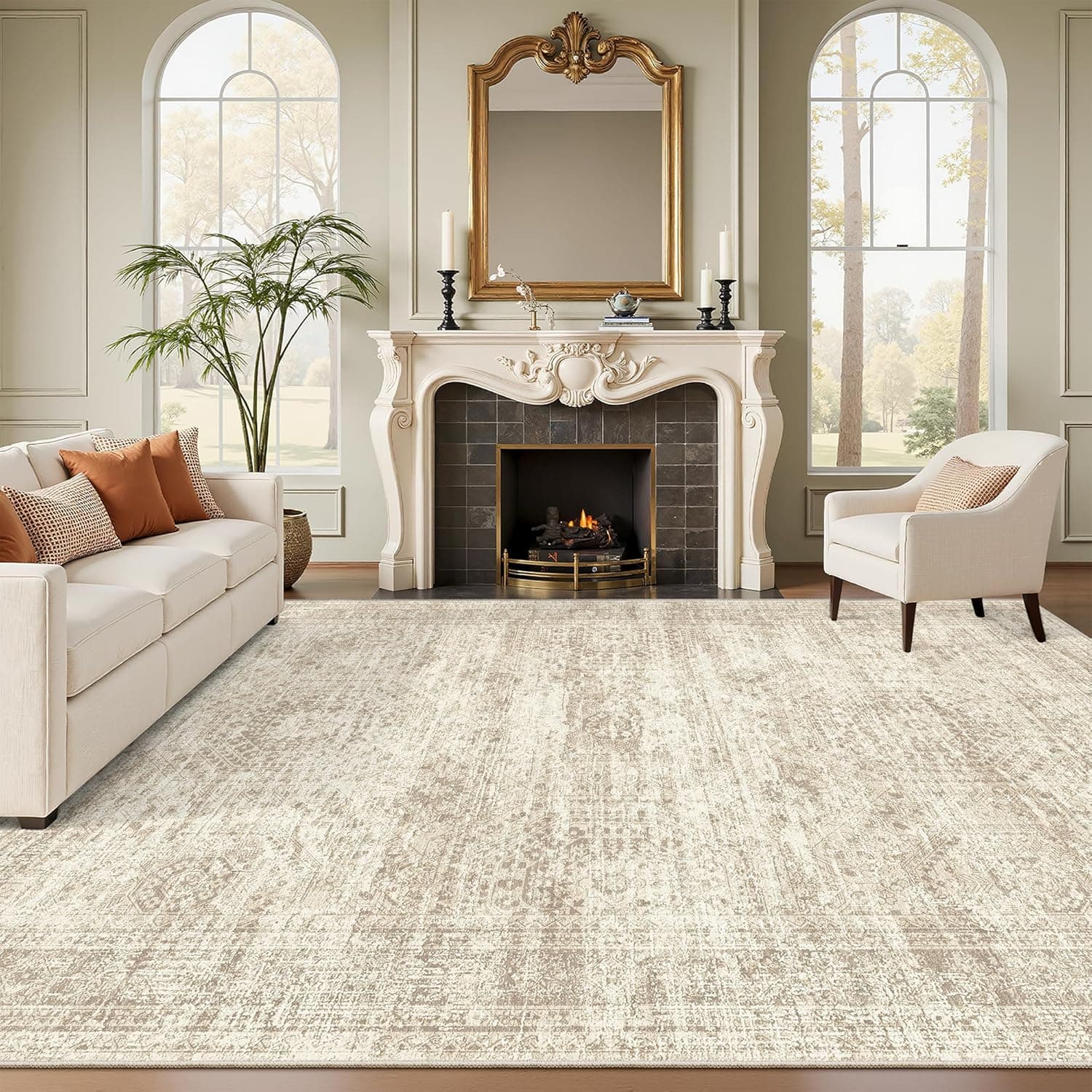
Soalmost Washable Area Rug, 8 x 10 ft

Soalmost Washable Area Rug, 8 x 10 ft

Two rugs here state 8 by 10 ft. This is the only one whose listing also states low pile.

Eight by ten is the size at which a rug stops being an object on the floor and starts being the floor. The listing states a low pile that folds and is light enough to move, which is the practical difference between an 8 by 10 and a rolled carpet. Ninety-six by one hundred and twenty inches is a lot of rug to get through a doorway.

The listing states
vintage non-slip, stain resistant, low pile, foldable and lightweight.
Best for
A seating group you want sitting entirely on one rug.

What works

  • Ninety-six by one hundred and twenty inches, the larger of the two footprints this catalog carries.
  • The listing states a low pile, which is the pile a door clears and a chair leg slides over.
  • Foldable and lightweight, per the listing, which is not stated of every rug this size.
  • Stain resistant, per the listing, which is at least a claim you can hold it to.

What does not

  • The listing gives no pile height in inches, only the word low.
  • Non-slip is the seller’s word, not a measurement and not a standard.
  • A rug this size arrives folded, and the listing does not say how long the creases take to settle.
Check the listing

Only adjustable shade

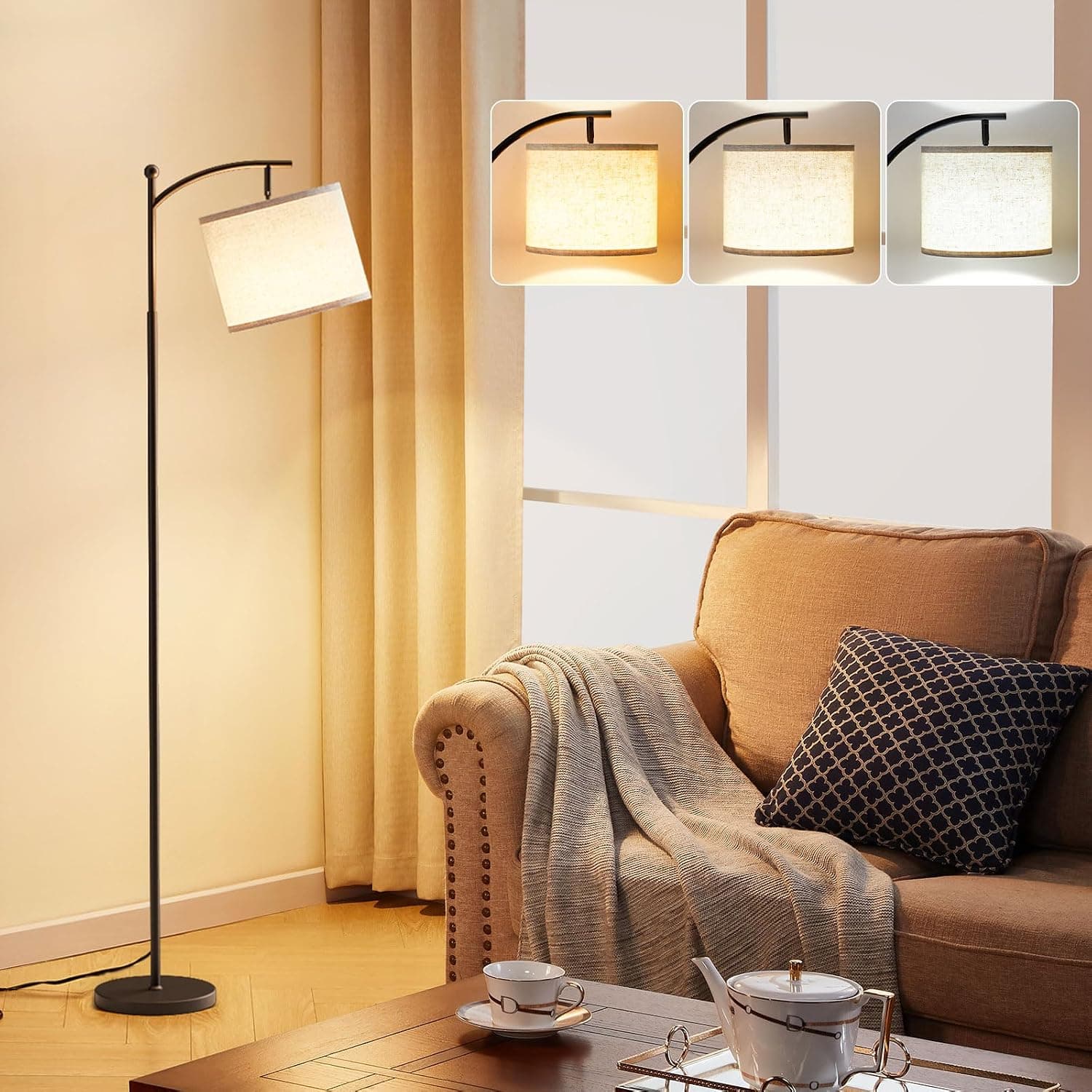
Ambimall Floor Lamp with Linen Shade, 60 in

Ambimall Floor Lamp with Linen Shade, 60 in

The only floor lamp here whose listing states an adjustable shade. Eight other listings state a fixed head or no shade adjustment at all.

Sixty inches overall with a shade that the listing says adjusts, which is the one variable that decides whether light lands on a page or on the ceiling. A seated adult’s eye sits somewhere around 40 to 44 in off the floor, and a 60 in lamp puts the bottom of the shade near that line. The listing states a 9W bulb in the box and three color temperatures.

The listing states
a 9W LED bulb, 3 color temperatures and an adjustable linen shade.
Best for
Beside a sofa arm, where the shade sits at seated height.

What works

  • Sixty inches overall, which puts a shade near seated eye level rather than above it.
  • The only lamp here whose listing states an adjustable shade.
  • A 9W LED bulb is stated as included, so nothing else is needed to switch it on.
  • Three color temperatures are stated, which is a choice of light tint.

What does not

  • The listing gives no shade diameter, so the spread of light is unknown.
  • Nine watts is the bulb the listing names; the fixture’s own maximum wattage is not stated.
  • Color temperature is stated as a count of settings, not as Kelvin figures.
Check the listing

Only 2200 K stated

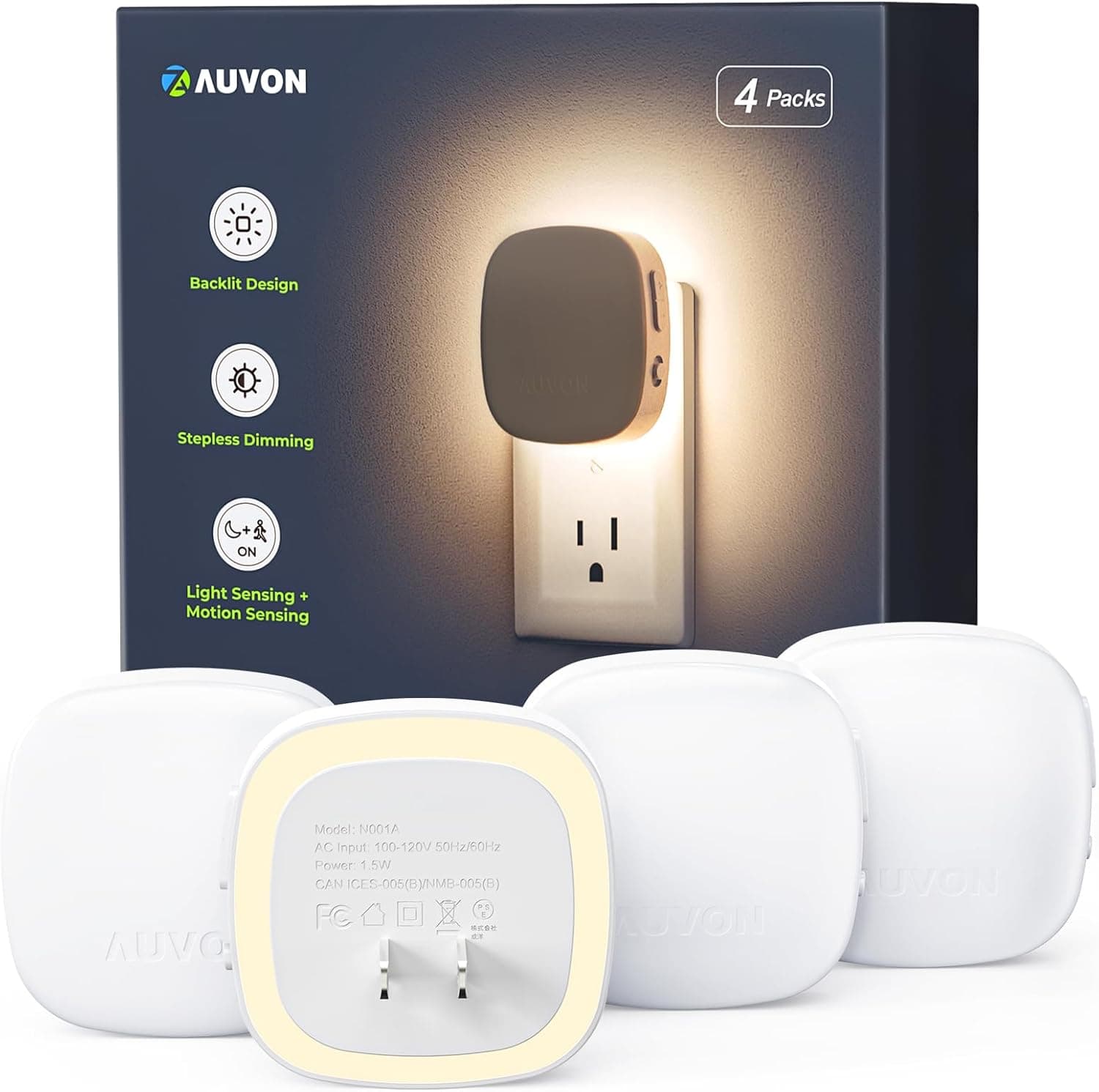
AUVON Backlit Night Light, 4-pack

AUVON Backlit Night Light, 4-pack

2200K appears exactly once in this catalog. Every other night-light listing here states 3000K, warm white or daylight white.

The only listing in this category that states a bottom end to its output, and that bottom end is 1 lumen. One lumen is about as little light as a device can make and still be on. The listing states 2200K, which is a warmer tint than the 3000K the rest of this category uses, and it states both a motion sensor and a dusk-to-dawn sensor.

The listing states
motion and dusk to dawn sensors, 2200K, and 1 to 50 lm dimmable output.
Best for
A hallway outlet where the lowest possible setting is the point.

What works

  • One lumen at the low end is stated, the lowest figure any listing here gives.
  • Both sensors are stated, so it can respond to darkness and to movement.
  • 2200K is stated as a number rather than as a word like warm.
  • Fifty lumens at the top means it can also be turned up.

What does not

  • Four units is a lot to buy to test whether the tint suits a hallway.
  • The listing states no beam angle, so the spread on a wall is unknown.
  • A backlit panel is wider than a plain plug, and may crowd a two-socket outlet.
Check the listing

Tallest stated height

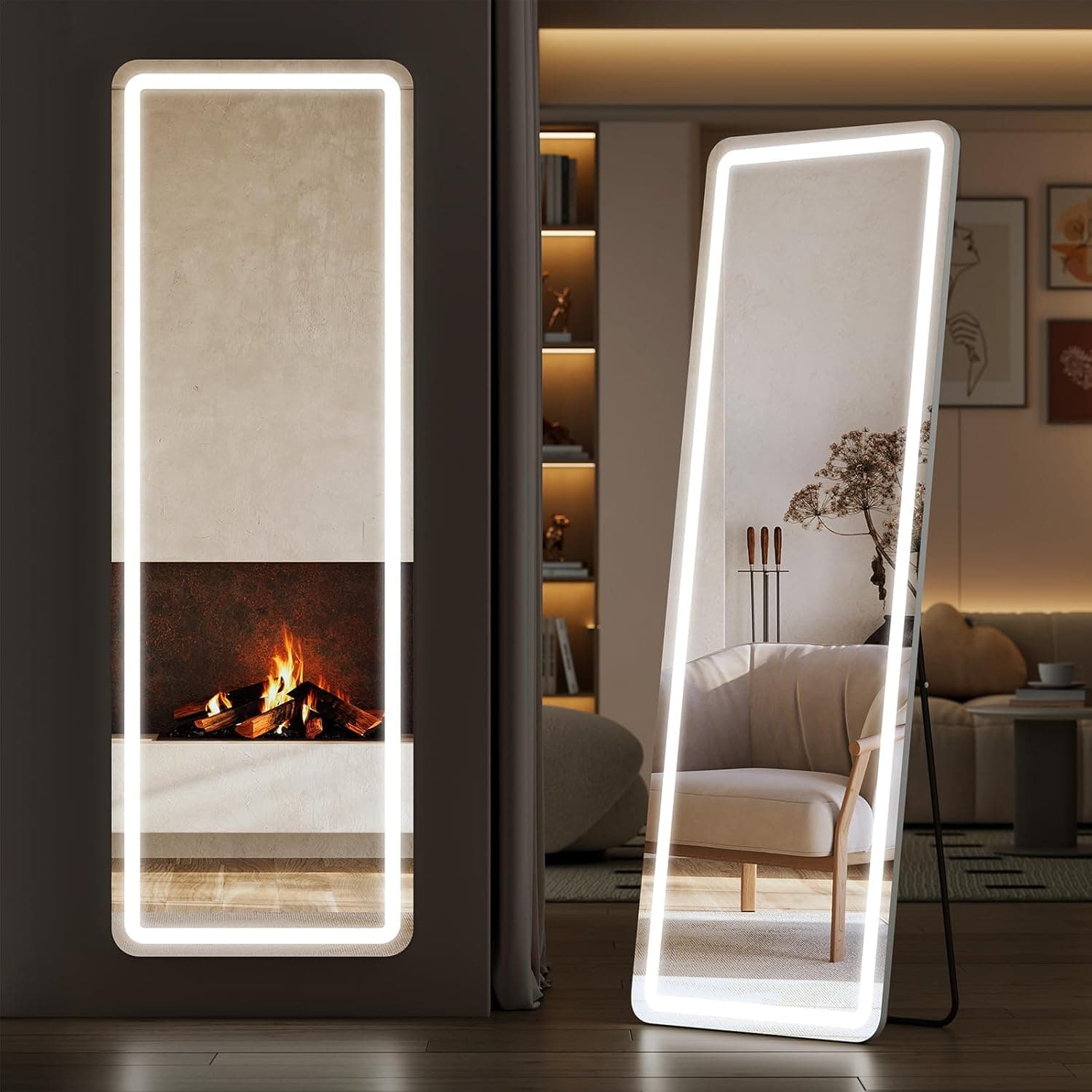
Sweetcrispy LED Full-Length Mirror, 65 x 21 in

Sweetcrispy LED Full-Length Mirror, 65 x 21 in

65 in, the tallest stated height in this catalog. No other mirror here states 65 in.

Sixty-five inches is the tallest stated height in this catalog, and height is the whole argument in a full-length mirror. A 5 ft 10 in person standing about 3 ft back needs roughly half their height in glass, hung at the right level, to see themselves head to foot. Twenty-one inches wide is on the generous side of what this catalog offers. The listing states shatterproof tempered glass and lighting in three tints.

The listing states
dimming, 3 color lighting and shatterproof tempered glass, with wall hanging or leaning.
Best for
A wall where the extra inches of height are available.

What works

  • Sixty-five inches, the tallest stated height in this catalog.
  • Twenty-one inches wide, which is wide enough to show shoulders without turning.
  • Dimming and three lighting tints are stated.
  • The listing states both wall hanging and leaning, so mounting is not forced.

What does not

  • Shatterproof and tempered are the seller’s terms, and this site did not verify either.
  • A lighted mirror needs power, and the listing does not state cord length.
  • Sixty-five by twenty-one inches is a large panel to hang on a wall you cannot see into.
Check the listing

Only stated load figure

BAYKA Floating Shelves, Set of 3, 15.7 in

BAYKA Floating Shelves, Set of 3, 15.7 in

22 lb is the only load figure stated by any of the eight shelf listings here. It is the seller’s claim, not a measurement made by this site.

The only listing in this catalog that puts a number on what a shelf will hold: 22 lb. That figure is the seller’s, and it describes the shelf, not the wall. Twenty-two pounds is roughly a dozen hardback books, or a stack of four large plates, which is worth knowing before the shelf is on the wall.

The listing states
a 22 lb capacity, a hidden bracket and rustic wood construction.
Best for
A wall where a stated load figure is what you were looking for.

What works

  • A stated load figure, which eight other shelf listings here do not give.
  • Fifteen and seven-tenths inches, the most common length in this catalog.
  • A hidden bracket is stated, which is what makes a shelf look like it floats.
  • Three shelves in a set, enough for a stacked arrangement.

What does not

  • 22 lb is a listing claim about the shelf, and what a wall holds is a separate question entirely.
  • The listing states no depth, so the shelf’s reach from the wall is unknown.
  • Rustic wood is a finish description, not a species or a thickness.
Check the listing

52 in wide, grommet

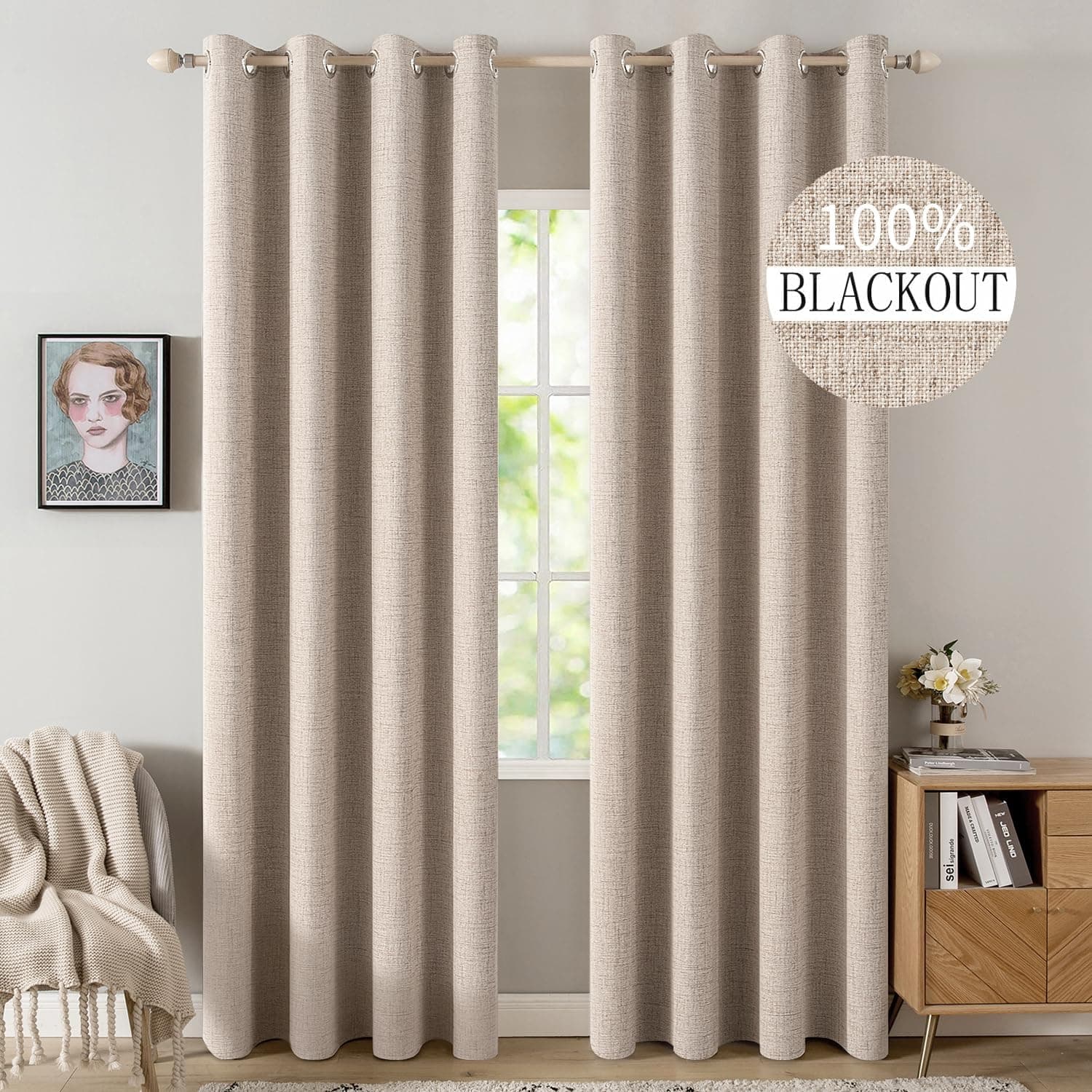
MIULEE Blackout Linen Curtains, 52 x 84 in

MIULEE Blackout Linen Curtains, 52 x 84 in

The listing states 52 by 84 in with a grommet top. One other panel here states the same 52 in width.

Fifty-two by eighty-four inches, which is the combination this catalog is best at: the long drop and the wider of the two panel widths on offer. Two panels at 52 in gives 104 in of flat fabric, and a grommet header gathers that down to something like 60 to 70 in of covered width. The listing states 100% blackout, which is the seller’s phrase for the fabric and says nothing about the gap at the edges.

The listing states
100% blackout, thermal insulation, a grommet top, a linen texture and 2 panels.
Best for
A rod-to-floor drop close to 84 in with a window up to about 50 in wide.

What works

  • Eighty-four inches of drop, the longer of the two lengths this catalog carries.
  • Fifty-two inches per panel, the wider of the two stated widths.
  • A grommet top, which slides and stacks more easily than a rod pocket.
  • A linen texture, per the listing, which hangs with more weight than a flat weave.

What does not

  • 100% blackout describes the fabric, and light still arrives around the sides and over the top of any panel.
  • The listing states no fabric weight, so the fall of the panel is unknown.
  • Thermal insulation is stated without any figure attached to it.
Check the listing

All 52 listings, sorted by what they state: Gear

Why a 5 by 7 is almost always one size too small

Sixty by eighty-four inches sounds substantial until you put it next to the thing it has to relate to. A three-seat sofa is around 84 in wide on its own. Set a 5 by 7 in front of one and the rug is exactly as wide as the sofa and no wider, which means the chairs beside it stand on bare floor.

The arithmetic is unforgiving here. For front legs on, the rug wants to be roughly half the short dimension of the room at minimum. In a 12 ft room that is 72 in, and a 5 by 7 clears it. In a 14 ft room it is 84 in, and a 5 by 7 does not.

60 by 84 in

the most common footprint in this catalog, and the one that fits fewest rooms

Why 63 in suits almost nobody

Sixty-three inches is a length inherited from rooms with lower ceilings and rods mounted on the frame. It survives in production because it still sells, not because rooms changed back.

On an 8 ft ceiling with the rod hung 4 in above a standard window, rod to floor is around 88 in. A 63 in panel finishes 23 in above the floor. There is no header choice, no hem allowance and no styling decision that recovers 23 in.

23 in

of bare wall under a 63 in panel on a rod at 88 in

Why blackout still lights the edges

A curtain panel is a flat sheet hanging a few inches away from a wall. Light coming through a window travels along that gap and into the room at both sides, over the top of the panel where it hangs below the rod, and under the hem.

None of that is a property of the weave, so no fabric claim addresses it. Extending the rod further past the glass and hanging it higher both reduce the gaps. Neither closes them, and a listing that says 100% is describing cloth, not a room.

3 gaps

sides, over the top, under the hem — present on every panel regardless of fabric

What we will and will not do

How this site is written

  1. We have not tested anything. There is no lab here, no sample of any product, and no measurement of our own. Every figure attached to a product came off its listing.
  2. Where a listing states nothing, we print nothing and say the number is missing. We do not estimate a height from a photograph or infer a depth from a similar item.
  3. Claims like non-slip, shatter-proof, 100% blackout, invisible bracket and a stated pound rating are the seller’s words. We attribute them and we never restate them as fact.
  4. We do not compare products on safety, and we do not rank anything by it. Safety information here points at the organizations that publish it.
  5. Every sizing rule on this site is a common rule of thumb out of decorating practice. None of it is a standard, a code or a requirement, and we show the arithmetic so you can disagree with it.
  6. Links to Amazon are affiliate links. Nothing was ordered, described or placed differently because of that, and no listing paid to be here.

6 rules we hold ourselves to.

The Amazon links above are affiliate links, and a purchase made through one may earn us a commission. Nothing on this page was ranked, ordered or described differently because of that.

More on that: About and Affiliate Disclosure.